Jordan Guesthouse Math Favors Amman Short-Lets Over Dead Sea Hostel Strips
On my first trip to Jordan, I booked three nights at the Dead Sea Hostel (not its real name) without doing the math. The dorm bed cost US$ 15 a night—cheap on paper. But by the time I factored in marked-up snacks from the hostel's tiny shop, a day-use fee for the pool, and the shared taxi back to Amman, I had spent nearly as much as a friend who had booked a private short-let in Jabal Amman and cooked her own meals. That experience started me comparing lodging trade-offs across Jordan, and the numbers consistently favor Amman short-lets and guesthouses over the Dead Sea hostel strip—for a certain kind of traveler, at least.
The Amman Short-Let Math Beats the Hostel Strip
Let's start with the headline numbers. A private short-let apartment in Amman—say, a studio or one-bedroom in Jabal Amman or near Abdali—typically runs between US$ 25 and 40 per night, as of late 2024. That gets you a kitchen, a washing machine, and a quiet space to sleep. A dorm bed in a Dead Sea hostel, meanwhile, costs around US$ 12 to 18 per night. The gap looks wide, but it narrows fast once you add the extras.
Dinner at a Dead Sea hostel might set you back US$ 8–12 for a basic meal, whereas cooking pasta in your Amman short-let costs maybe US$ 2–3. Transport from Amman to the Dead Sea in a shared taxi runs roughly US$ 5–7 each way. If you stay at the Dead Sea, you'll likely want to use the hostel's pool or the public beach—day-use fees can add another US$ 5–10. Suddenly, that US$ 15 dorm bed becomes a US$ 35–50 nightly total, while the Amman short-let stays near US$ 30–45 including a home-cooked meal.
The short-let also gives you amenities hostels rarely offer: a washing machine (handy after a day in the Dead Sea mud), a fridge to store leftovers, and silence after 10 p.m. The hostel strip sells proximity to the sea, but that proximity comes with a premium that's easy to overlook when you're booking on a phone screen.
Of course, not everyone wants to cook on vacation. If you're the type who prefers eating out every meal and meeting other travelers in a common room, the Dead Sea hostel might still make sense. But for solo travelers or couples who value space and quiet, the Amman short-let math is hard to beat.
Why the Dead Sea Hostel Strip Overcharges for Basics
The Dead Sea hostel strip—a loose cluster of budget lodgings near the public beach, about 2–3 kilometers from the resort hotels—has a captive-audience problem. There is no supermarket within walking distance. The small shops near the hostels sell water, snacks, and toiletries at prices 50–100% higher than Amman supermarkets. A 1.5-liter bottle of water that costs US$ 0.30 in Amman might be US$ 0.80 here. Day-use pool access is another hidden cost. Many hostels have a pool, but non-guests (and sometimes even guests) pay an extra US$ 5–10 to use it. The public beach entry is US$ 5–7, but there are no showers or changing facilities—you rinse off with a hose. Compare that to Amman guesthouses, where rooftop terraces and common areas are usually included in the room rate.
The dorm bed price, US$ 12–18, rivals a budget hotel room in Amman's downtown—where you can find a private double for US$ 20–30. The difference in experience is enormous: a private room with a door that locks, versus a bunk in a room with three other strangers. And the Dead Sea hostels are not particularly social. I've stayed in two, and both had a tired, transient vibe—people passing through for one night before moving on to Petra or Wadi Rum.
Transport to Amman adds another layer. A shared taxi costs roughly US$ 5–7 each way, but drivers often wait until the car is full, which can take 20–30 minutes. If you're making a day trip, that's an hour of your day spent waiting. If you're staying overnight, you pay that taxi fare twice.
Amman Guesthouses: Mid-Range Sweet Spot in Jabal Amman
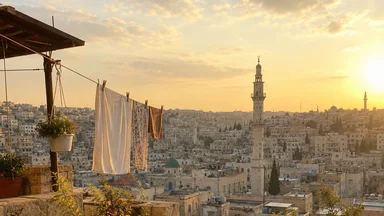
Amman's guesthouses, particularly in the historic Jabal Amman neighborhood, offer what I consider the sweet spot for mid-range travelers. A private room with a shared bathroom in a guesthouse like the one I stayed at runs US$ 30–50 per night, often with breakfast included. The building is usually a restored Ottoman-era house with high ceilings, a tiled courtyard, and a roof terrace with views of the city's hills.
From Jabal Amman, you can walk to Rainbow Street—a strip of cafes, restaurants, and souvenir shops—in 10 minutes. The Amman Citadel and the Roman Theatre are a 20-minute walk downhill. The neighborhood itself is quiet at night, with narrow streets and jasmine vines. The guesthouse common area becomes a de facto living room where you can meet other travelers over mint tea.
Compare that to a hostel dorm in downtown Amman, which goes for US$ 10–15 per night. You get a bed in a noisy room, no kitchen, and often no common space worth lingering in. The location is central, but the trade-off is noise from traffic and street vendors until late. A short-let near Abdali, the modern business district, costs US$ 35–55 and offers more space—a full apartment—but less charm. The streets are wider, the buildings newer, and the neighborhood feels sterile after dark.
For a traveler who wants character and a base to explore the city, the Jabal Amman guesthouse is the clear winner. It's not the cheapest option, but the value—breakfast, roof terrace, walkable location—is hard to replicate.
The Hidden Cost of Proximity: Dead Sea Day-Trip vs Stay
The most common question I get from travelers planning Jordan is: should I stay at the Dead Sea or do a day trip from Amman? The answer depends on how you value your time and money, but the math leans toward the day trip for most budget travelers.
A day trip from Amman by bus costs roughly US$ 10–15 round trip. The public beach entry is US$ 5–7, though you get no shower. If you want a resort day pass—which includes a pool, clean changing rooms, and a buffet lunch—that runs US$ 25–40. Total for a day trip: US$ 40–62.
An overnight stay at a Dead Sea hostel, on the other hand, costs US$ 12–18 for the dorm bed, plus dinner (US$ 8–12), breakfast (US$ 5–8), and a day-use fee if you want pool access (US$ 5–10). Add transport to and from Amman (US$ 10–14 total), and you're looking at US$ 40–62 as well—almost identical. But the day trip gives you a full day at the Dead Sea without the hassle of checking in and out, and you sleep in your own bed in Amman.
The exception is if you want to watch the sunset over the Dead Sea and then have a relaxed dinner. In that case, an overnight stay lets you avoid the rush back to Amman. But for most people, the day trip offers better value: you get the same float in the hyper-saline water, the same mud bath, and you save the cost of an extra night's lodging.
One caveat: if you book a resort day pass, check whether it includes a towel and locker. Some resorts charge extra, and those fees add up.
Neighborhood Math: Where the Budget Goes Further
Amman's neighborhoods offer wildly different value propositions. Jabal Amman, as mentioned, gives you character and walkability for US$ 30–50 a night. The trade-off is that many guesthouses are uphill, and the walk from downtown can be strenuous in summer heat. Taxis within Amman cost around US$ 2–5 per ride, so factor that in.
Downtown Amman (Al-Balad) has the cheapest dorms—US$ 10–20—but they're noisy and often cramped. You're steps from the Roman Theatre and the souks, but the area empties out after 9 p.m. and can feel sketchy. I've met travelers who loved the energy and others who moved after one night due to noise.
Abdali, the new downtown, is a transit hub with modern high-rises and a bus station for long-distance routes. Short-lets here cost US$ 40–60, and you get a clean, functional apartment. But the area lacks soul—it's all glass and concrete, with few cafes or shops that invite lingering. It's a good base if you're relying on buses to Petra or the King's Highway, but not for exploring Amman itself.
West Amman, including neighborhoods like Sweifieh and Abdoun, is upscale and expensive. Short-lets run US$ 50–80, and you're far from tourist sites. You'd need a car or frequent taxis. This is where expats and wealthy Jordanians live, and it shows in the prices. For a budget traveler, it's hard to justify unless you have specific reasons to be there.
The Dead Sea strip has limited options: a handful of hostels and a couple of mid-range hotels. Prices are inflated relative to quality. A private room in a Dead Sea hotel can cost US$ 60–100, which is more than a short-let in Amman and offers less space. The only reason to stay there is if you want to roll out of bed and into the water.
Stale Data Alert: Booking.Com Prices Shift by Season
All the numbers in this article come with a freshness warning. A 2019 survey by the Jordan Tourism Board listed Amman guesthouse prices at US$ 25–40; by 2023, those same guesthouses were US$ 30–50. Dead Sea hostel dorms that were US$ 10–12 in 2019 now run US$ 15–20. The Jordan Tourism Board last published official rate guidance in 2022, so current data is patchy.
Seasonal swings are dramatic. During Ramadan, many hotels and hostels offer reduced rates because demand drops—locals are fasting and tourism slows. But Easter week and Christmas can spike prices 20–40% above baseline. I've seen a Jabal Amman guesthouse that normally costs US$ 35 jump to US$ 55 during the Easter holiday. Always check cancellation policies; no-shows are common in Jordan, and some hostels charge the full amount if you cancel within 48 hours.
Another data point: the Jordan Pass, which waives the visa fee if you stay at least three nights, has pushed some travelers toward longer stays. But the pass doesn't cover lodging, so it doesn't change the cost comparison between Amman and Dead Sea accommodations. It's worth noting that the pass includes entry to over 40 sites, including the Dead Sea beach area, but not resort facilities.
A general tip: use Booking.com or Airbnb to check current prices, but cross-reference with direct booking rates. Some guesthouses offer 10–15% discounts if you book directly, especially in low season. And don't rely on prices you read in an article from 2024—mine included.
Final Tally: Three-Night Stay Scenarios Compared
Let's put it all together with three realistic three-night scenarios. Scenario A: three nights at a Dead Sea hostel. Dorm bed: US$ 45–60 (US$ 15–20 per night). Meals: US$ 30–45 (US$ 10–15 per day). Transport to and from Amman: US$ 10–14. Day-use fees: US$ 10–15. Total: US$ 95–134. You get proximity to the Dead Sea but limited amenities and a noisy dorm.
Scenario B: three nights in an Amman short-let plus a day trip to the Dead Sea. Short-let: US$ 75–120 (US$ 25–40 per night). Day trip: US$ 40–62 (bus + resort day pass). Meals for other two days: US$ 20–30 (cooking at home). Total: US$ 135–212. You get a private apartment, a washing machine, and a quiet base. You also get a full day at the Dead Sea with resort facilities.
Scenario C: two nights in an Amman guesthouse plus one night at a Dead Sea hostel. Guesthouse: US$ 60–100 (US$ 30–50 per night). Dead Sea hostel: US$ 15–20 for one night. Meals: US$ 25–40. Transport: US$ 10–14. Total: US$ 110–174. This gives you variety: the charm of Jabal Amman and the experience of a Dead Sea sunset. It's the most balanced option.
Scenario B wins on amenities, cooking, and quiet. Scenario C is best for variety, and you can often book the Dead Sea hostel last-minute if the weather looks good. Scenario A is only worth it if you're on a shoestring and don't mind the trade-offs—the cramped dorm, the captive pricing, the time lost to transport. For travelers who can stretch the budget a little, the extra money spent on an Amman short-let or guesthouse buys a noticeably better experience.