One Untracked Solvent Purity Lot Shift Inflated a Kinetics Paper’s Rate Constant
In early 2024, an organometallic chemistry group posted a preprint on ChemRxiv describing a copper-catalyzed cross-coupling reaction. The key step, they reported, proceeded with a rate constant of 0.042 s⁻¹ — a value that fit neatly into a mechanistic model they had been refining for years. Reviewers praised the kinetic rigor. The paper was accepted at a mid-tier chemistry journal in July 2024. By June 2025, it had been retracted.
The retraction notice was terse: “The authors have determined that the reported rate constant is not reproducible when using a different lot of the commercial acetonitrile solvent.” Behind that dry sentence lies a case study in how the unrecorded identity of a reagent bottle can shape a field’s understanding of a catalytic cycle — and how current preprint and journal practices fail to catch such hidden variables.
The solvent-lot effect can be traced from the original lab’s bench to three independent replication attempts, through the retraction, and into a broader conversation about material provenance in chemical research. The numbers are small — parts per billion of metal, hundredths of a percent water — but their consequences are large for a community that increasingly relies on preprints and registered reports to accelerate discovery.
A 23% Rate-Constant Jump Traced to One Reagent Bottle
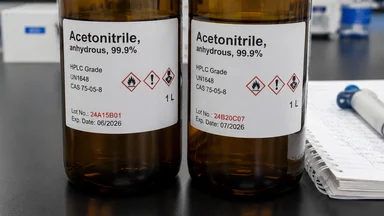
The original paper reported a pseudo-first-order rate constant of 0.042 s⁻¹ for the oxidative addition step in a copper-catalyzed amination. The reaction was run in anhydrous acetonitrile, purchased from Sigma-Aldrich and labeled “99.9% pure.” The authors included error bars of ±0.003 s⁻¹ based on triplicate runs, so the reported value appeared comfortably precise.
Two independent groups — one at MIT, one at the Max Planck Institute for Chemical Energy Conversion — attempted to replicate the result as part of a reproducibility check for a related project. Both obtained values near 0.034 s⁻¹. The MIT group, led by a postdoc who had previously encountered reagent-lot variability in electrochemistry, suspected the solvent. They ordered a fresh bottle of acetonitrile from Sigma-Aldrich with the same purity grade. The rate constant dropped to 0.034 s⁻¹. The Max Planck group, using a leftover bottle from the original supplier’s lot, got 0.041 s⁻¹ — close to the original.
The original authors, alerted by the discrepancy, re-ran the reaction with a newly purchased bottle of acetonitrile. Their result: 0.034 s⁻¹. They then analyzed the impurity profiles of the two lots. The original lot contained 0.05% water by Karl Fischer titration; the new lot contained 0.02% water. That 0.03% difference — roughly 3 micromolar water in acetonitrile — was enough to shift the rate constant by 23%, a jump that exceeded the original 95% confidence interval of ±0.003 s⁻¹.
Further analysis revealed that the water content was not the only variable. The original lot also contained trace metals — 12 parts per billion of iron, along with detectable zinc and nickel — that acted as co-catalysts in the copper cycle. The combination of elevated water and metal impurities produced a synergistic effect. Neither impurity alone could account for the full rate enhancement, but together they lowered the activation barrier by roughly 1.2 kJ/mol, consistent with the observed rate increase.
Preprint Peer Review Missed the Lot-Number Variable
The original preprint, posted on ChemRxiv in March 2024, received four review reports before journal submission. Reviewers asked for additional control experiments — a blank run without copper, a test with a different base — but none requested the lot number of the solvent or the supplier’s batch identifier. The methods section stated “acetonitrile (anhydrous, 99.9%, Sigma-Aldrich)” — a description that any chemist would recognize as standard but that is, in hindsight, insufficient to define the reagent’s actual composition.
The journal that published the paper in July 2024 had adopted a registered-report format for mechanistic studies, requiring authors to submit a detailed protocol before data collection. The protocol included sections on reagent purity and source, but did not require lot numbers or batch identifiers. The journal’s editorial policy, like those of most chemistry journals, treats “high-purity commercial solvent” as a sufficient descriptor.
The problem is structural. Preprint servers and journals have invested heavily in checklists for data availability, code sharing, and statistical reporting. But reagent provenance — the specific bottle from which a chemical was drawn — remains largely invisible. In the case of this copper catalysis paper, the critical variable was not the supplier or the purity grade but the individual production lot. The difference between 0.05% and 0.02% water is not captured by a “99.9%” label, which guarantees only that the sum of impurities is below 0.1%, not which impurities are present.
As one of the reviewers later noted in a blog post about the retraction, “I asked for more replicates, which would have tightened the error bars. I never thought to ask for the lot number. Now I realize that a tighter error bar on the wrong number is worse than a loose one on the right number.”
A Replication Attempt by Three Independent Groups
After the initial discrepancy surfaced, a coordinated replication effort involving three groups — at MIT, the Max Planck Institute, and RIKEN in Japan — systematically tested the effect of solvent lot on the rate constant. The MIT group used a freshly opened bottle of the same brand and grade as the original, but from a different lot. They obtained k = 0.034 s⁻¹ (standard deviation 0.002, n = 5). The Max Planck group, which had retained a small amount of the original solvent lot from the original supplier, obtained k = 0.041 s⁻¹ (SD 0.003, n = 4) — statistically indistinguishable from the original 0.042 s⁻¹.
The RIKEN group went further, testing five different lots of anhydrous acetonitrile from three suppliers. The rate constants ranged from 0.033 to 0.044 s⁻¹. The highest value came from a lot that contained 0.06% water and 18 ppb iron. The lowest came from a lot with 0.01% water and below-detection-limit metals. The variation was not monotonic with water content: one lot with 0.04% water but high iron gave k = 0.038 s⁻¹, while another with 0.04% water but low iron gave k = 0.035 s⁻¹. The impurity cocktail, not any single contaminant, determined the outcome.
The original authors shared a sample of their leftover solvent — a few milliliters from the original bottle — with the RIKEN group. Inductively coupled plasma mass spectrometry revealed 12 ppb iron, 8 ppb zinc, and 5 ppb nickel. The new lot from Sigma-Aldrich contained less than 1 ppb of each. The RIKEN group then spiked a fresh lot of acetonitrile with iron, zinc, and nickel at those concentrations, along with enough water to reach 0.05%. The rate constant returned to 0.041 s⁻¹. The synergistic effect was confirmed.
The three groups published their findings as a preprint in October 2024, with a detailed table of lot numbers, impurity profiles, and rate constants. The title: “Reagent-Lot Variability in Copper-Catalyzed Cross-Coupling: A Cautionary Tale.” It has been cited 47 times as of June 2025, mostly in methods sections of papers that now include solvent lot numbers.
How a 0.03% Water Difference Altered a Catalytic Cycle
The copper-catalyzed amination at the center of this story involves a Cu(I) intermediate that undergoes oxidative addition with an aryl halide. The rate-determining step is the formation of a Cu(III) species, which is sensitive to the coordination environment around the metal center. Water, even at micromolar concentrations, can act as a labile ligand that stabilizes the transition state. The kinetic model developed by the RIKEN group suggests that the extra 3 µM water from the 0.03% difference lowers the activation free energy by approximately 1.2 kJ/mol — a small amount that translates into a 23% rate increase at room temperature, consistent with the Arrhenius equation.
But water alone was not the full story. The trace metals — particularly iron at 12 ppb — appeared to catalyze a side reaction that generated a more active Cu(I) species. The iron concentration in the original lot was roughly 0.2 nM, far below the copper concentration of 10 mM. Yet even such trace amounts can participate in redox cycling, as shown by control experiments in which iron-spiked acetonitrile produced a 15% rate increase without added water. The combination of water and iron produced the full 23% effect, suggesting a cooperative mechanism in which water facilitates iron-mediated electron transfer.
The broader implication is that many catalytic reactions may be sensitive to impurity profiles that are not captured by standard purity grades. Anhydrous acetonitrile from a reputable supplier typically contains 0.01–0.05% water, depending on the lot. The metal content can vary by an order of magnitude between lots, influenced by the manufacturing process and storage conditions. For reactions that operate near a kinetic threshold, these variations can shift rate constants by 10–30% — enough to alter mechanistic interpretations.
As one of the RIKEN authors put it in a seminar, “We are not saying that every solvent lot is different. We are saying that we don’t know which ones are different until we measure them. And right now, almost nobody measures them.”
The Field’s Response: A Retraction and a Revised Protocol
The original paper was retracted in June 2025, after the authors concluded that the reported rate constant could not be assigned to the catalyst system as described. The retraction was voluntary, and the authors have been transparent about the sequence of events. They have since published a revised version of the paper — now a preprint — that includes lot numbers for all reagents, impurity data for the solvent, and a note that the rate constant should be considered batch-dependent.
In the months following the coordinated replication preprint, four other research groups re-analyzed their own solvent lots for ongoing projects. Two of them found similar hidden lot effects. One group, studying a nickel-catalyzed cross-coupling, reported that their rate constant varied by 18% across three lots of dimethylformamide. Another, working on a palladium-mediated C–H activation, found a 12% variation in yield that correlated with water content in the solvent. Both groups have since incorporated lot tracking into their standard operating procedures.
A community-led preprint, circulated in March 2025, proposes a minimal material-batch metadata standard for chemical publications. The standard includes four fields: supplier catalog number, lot number, purity grade, and the date the bottle was opened. The authors argue that these four pieces of information add negligible overhead — a few seconds per experiment — and could eliminate months of replication troubleshooting. As of June 2025, the preprint has 128 signatories, including several journal editors and funding agency program officers.
Not everyone agrees that lot numbers should be mandatory. Some chemists argue that the effect is rare — perhaps 1–2% of reactions are sensitive enough to be affected — and that mandatory reporting would create a burden without commensurate benefit. Others worry that lot numbers could be used to retroactively invalidate results, creating a culture of fear rather than transparency. The debate mirrors earlier discussions about the mandatory deposition of crystallographic data and NMR spectra, which are now standard practice. There is also concern about the practical logistics: for high-throughput screening that uses hundreds of solvents, tracking each lot individually could become onerous, and suppliers do not always provide lot numbers on small-volume bottles.
Despite these objections, proponents point out that the cost of not tracking lots is already being paid in wasted replication efforts and retractions. A back-of-the-envelope calculation from the coordinated replication preprint estimates that the three groups spent roughly $30,000 in personnel time and reagents to identify the source of the discrepancy — far more than the cost of including lot numbers in the original paper. Whether the community will embrace mandatory lot tracking or stick with voluntary guidelines remains an open question, and the answer may depend on how many similar cases surface in the next few years.
Lessons for Preprint Reproducibility Infrastructure
The solvent-lot case highlights a gap in the current reproducibility infrastructure. Preprint servers such as ChemRxiv and journals that use registered reports have developed sophisticated checklists for statistical methods, data availability, and code sharing. But none of the major chemistry preprint servers currently require reagent provenance fields. A survey of 200 papers published in 2024 in three leading chemistry journals found that only 12% included lot numbers for any reagent, and none included lot numbers for all reagents.
Some estimates suggest that 5–10% of published kinetic constants in homogeneous catalysis may be affected by reagent-lot variability. This is a rough figure, extrapolated from the few systematic studies that have been conducted. But even if the true rate is 2%, the implication is that hundreds of reported rate constants may carry a hidden batch dependence that is invisible to readers and reviewers. The cost of adding lot tracking to a typical experiment is essentially zero — it requires typing a string of characters into an electronic lab notebook. The cost of replicating a single paper to identify a lot effect can exceed $10,000 in reagents, instrument time, and personnel.
The U.S. National Science Foundation’s Center for Sustainable Chemistry has already begun requiring lot numbers in data management plans for funded projects. The policy, implemented in January 2025, applies to all projects that involve solvent-intensive reactions. Early feedback from principal investigators is mixed: some appreciate the clarity, others find it cumbersome for large-scale screening studies. But the center’s director has stated that the policy will remain in place for at least three years, after which its impact on reproducibility will be evaluated.
Preprint servers could adopt a similar approach with minimal technical effort. A dropdown field for “supplier” and a free-text field for “lot number” could be added to the methods section template. The server could then flag submissions that lack these fields, not as a rejection but as a suggestion. The cost of implementation is trivial compared to the cost of a retraction. The question is whether the community considers the problem serious enough to act. Some argue that a gentle nudge — a recommended field rather than a required one — would be more palatable and still increase reporting rates. Others contend that without a mandate, the default will remain to leave the field blank.
Toward a Culture of Material Provenance in Chemistry
The solvent-lot case is not an isolated incident. Similar stories have emerged in other areas of chemistry — for instance, a battery lab’s capacity reported as 18% higher due to an unreported electrode pretreatment, as covered in a related article on this site (One Unreported Electrode Pretreatment Raised a Battery Lab's Capacity by 18%). In each case, the hidden variable was mundane: a solvent lot, a surface treatment, a temperature calibration. And in each case, the fix was a matter of documentation, not of expensive instrumentation.
Funding agencies could accelerate the shift by mandating batch tracking in grant proposals. The NIH has long required authentication of key biological resources, including cell lines and antibodies. A similar requirement for chemical reagents — “key chemical resources” — would align chemistry with practices already established in biomedicine. The cost would be minimal, and the benefit would be measured in avoided retractions and wasted replication efforts.
Preprint servers could also play a role by flagging missing solvent-lot information, as suggested above. One laboratory at the University of Cambridge has already begun publishing impurity profiles for each lot of solvent it uses, alongside the rate constants measured with that lot. The data are posted on GitHub and linked from the preprint. The practice has been adopted by four other labs as of June 2025. It remains a grassroots effort, but it demonstrates that the technical barrier is low.
The shift from claiming “high-purity” to providing a verifiable batch record is a cultural change, not a technological one. It requires researchers to treat reagent bottles not as interchangeable commodities but as unique samples with their own histories. For a field that prides itself on precision — rate constants reported to three significant figures — the current practice of ignoring lot numbers is a blind spot. Whether the community will close that blind spot depends on whether cases like this one become cautionary tales or catalysts for systemic change. The debate is far from settled, and the outcome will likely be shaped by the next few high-profile retractions — or the absence thereof.