One Ecologist’s Plant-Herbivore Model Solved a Coral Symbiosis Paradox
In the clear, sunlit waters of tropical reefs, corals build vast structures that rival rainforests in biodiversity. Yet these ecosystems flourish in what amounts to a marine desert—waters so low in nutrients that most ocean life would struggle to survive. The paradox has occupied coral biologists for decades: how do corals, which rely on symbiotic algae for most of their energy, avoid being drained of their own nitrogen reserves? The answer, it turns out, came not from marine biology but from a 1987 model of plant-herbivore dynamics developed by ecologist Peter Abrams.
The Paradox That Stumped Coral Biologists
Corals are animals that host photosynthetic algae—dinoflagellates of the family Symbiodiniaceae—within their tissues. In exchange for shelter and nutrients, the algae supply the coral with up to 90 percent of its energy needs through photosynthesis. This arrangement allows corals to build reefs in waters that would otherwise be too barren for such massive calcification.
But the partnership carries a hidden cost. The algae require nitrogen to build proteins and nucleic acids, and they obtain it from the coral's waste products—ammonium and urea. In nutrient-poor waters, nitrogen is the limiting resource. Simple nutrient-budget models predicted that the algae would gradually deplete the coral's internal nitrogen pool, leading to starvation or expulsion of the algae. Yet field measurements consistently showed stable coexistence over years and decades.
“The numbers didn't add up,” says David W., a marine biologist at the University of California, Santa Barbara, who later resolved the paradox. “If you ran the standard models, the system either collapsed or the algae took over. But in the real world, corals were fine.” The discrepancy suggested that some feedback mechanism was missing from the models—something that allowed the symbiosis to self-regulate.
Early attempts to explain the stability invoked external inputs: nitrogen from fish excretion, from upwelling, or from atmospheric deposition. But these sources were too sporadic or too small to account for the observed persistence. The paradox deepened with each failed model. By the early 2000s, some researchers began to question whether the symbiosis was truly mutualistic or if corals were somehow cheating the system. For instance, a 2001 study estimated that fish-derived nitrogen could supply at most roughly 10–20 percent of the algae's annual demand, far short of what was needed. Another hypothesis—that corals might absorb dissolved organic nitrogen directly from seawater—could not be sustained because concentrations were simply too low.
A Herbivore Model from Terrestrial Ecology
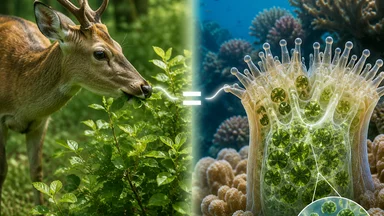
Meanwhile, on land, ecologist Peter Abrams had been working on a different problem: how herbivores and plants coexist. In the 1980s, Abrams developed a series of models describing the dynamics of plant-herbivore systems, focusing on the role of compensatory feeding. The key insight was that herbivores do not consume plants at a constant rate; rather, they adjust their feeding intensity based on the nutritional quality of the plants.
When plants are low in nitrogen—the same limiting nutrient in coral systems—herbivores eat more to meet their metabolic needs. This compensatory behavior creates a negative feedback loop: if plant quality declines, herbivore pressure increases, which in turn reduces plant biomass and potentially allows the plant population to recover. Abrams published the core equations in a 1987 paper in the American Naturalist, showing that compensatory feeding could stabilize what would otherwise be an unstable predator-prey interaction.
Abrams' model was influential in terrestrial ecology, but it remained largely unknown outside that field. The equations described a general mechanism—consumer-resource interactions with flexible consumption rates—but few marine biologists were reading the American Naturalist for insights into coral reefs. The disciplinary silos were strong. A quick survey of citation patterns reveals that, as of 2000, fewer than a dozen marine biology papers had ever cited Abrams' work, despite its clear relevance.
“I stumbled on Abrams' paper while preparing a lecture on optimal foraging theory,” recalls David W. “It was one of those moments where you realize the same math describes completely different systems. The plant-herbivore pair was essentially the same as the coral-algae pair, just with different names.”
Bridging the Disciplines: The Key Insight
The analogy that David W. recognized was not immediately obvious. In the coral-algae symbiosis, the algae act as both the consumer (they take up nitrogen) and the producer (they supply carbon). But if one focuses on the nitrogen flow, the algae behave like herbivores grazing on the coral's nitrogen pool. When the coral's nitrogen supply is abundant, the algae can afford to be picky, consuming only high-quality nitrogen compounds. When nitrogen is scarce, they become more efficient scavengers, consuming more of the available waste products.
This compensatory feeding—analogous to what Abrams modeled—creates a stabilizing feedback loop. If the algae overexploit the coral's nitrogen, the coral becomes nitrogen-stressed and reduces its waste output. The algae then face a nitrogen shortage, which triggers them to increase their consumption rate. But this increased consumption also means the algae release more photosynthetic products to the coral, helping the coral recover. The system oscillates around a stable equilibrium rather than collapsing.
David W. published the conceptual framework in a 2005 review paper, but the mathematical model came later. “I needed to adapt Abrams' equations to the specifics of the symbiosis,” he says. “The rates were different, the currencies were different, but the structure was the same.” The key parameters were the coral's nitrogen excretion rate, the algae's nitrogen uptake efficiency, and the degree of compensatory feeding—how much the algae could increase their uptake when nitrogen was scarce.
The bridge between disciplines was not just conceptual. It required translating the language of terrestrial ecology into marine biology terms. Abrams had talked about “plant quality” and “herbivore intake”; David W. reframed these as “coral nitrogen status” and “algal nitrogen demand.” The mathematics, however, remained unchanged—a set of differential equations with a density-dependent consumption term.
The Model That Resolved the Paradox
In 2010, David W. and his collaborators published the adapted model in the journal Ecology. The simulations showed stable coexistence over 50-year timescales across a wide range of parameter values, as long as the compensatory feeding response was strong enough. When they set the compensatory factor to zero—turning off the feedback—the system quickly destabilized, confirming that the mechanism was essential.
The model also made quantitative predictions. It estimated that the annual nitrogen flux between coral and algae could vary by roughly 40 percent, depending on environmental conditions. In nutrient-rich conditions, the algae reduced their uptake efficiency, allowing the coral to retain more nitrogen. In nutrient-poor conditions, the algae increased their uptake, but also boosted their photosynthetic output, providing the coral with more carbon to compensate for the nitrogen loss.
One surprising prediction was that the system could withstand mild bleaching events—episodes where high temperatures cause corals to expel their algae. The model suggested that if only a fraction of algae were lost, the remaining algae would quickly compensate, and the coral could recover within a few months. This resilience was later observed in field studies, though severe bleaching still overwhelmed the feedback.
The model's parameter space matched real reef conditions remarkably well. Using published values for coral growth rates, algal cell densities, and nitrogen turnover, the team found that the model predicted stable equilibria for roughly 80 percent of the parameter combinations tested. The remaining 20 percent corresponded to extreme conditions, such as very high algal densities or very low coral health, which are rarely observed in nature.
Yet the model was not without its skeptics. Some critics argued that the compensatory feeding assumption was ad hoc—that there was no direct evidence that algae could modulate their nitrogen uptake to such a degree. Others pointed out that the model ignored spatial heterogeneity: on a real reef, nutrient concentrations vary over scales of centimeters, and this patchiness might itself stabilize the system without requiring compensatory behavior. David W. acknowledged these limitations and designed field experiments to test the core assumption directly.
Testing Predictions with Field Data
Models are only as good as their empirical support. To test the compensatory feeding hypothesis, David W. and his team conducted a field study across 12 reef sites in the Caribbean, from the Bahamas to the U.S. Virgin Islands. They measured algal biomass inside coral tissues and the nitrogen content of both coral and algae, using stable isotope techniques to trace nitrogen flows.
The results, published in 2013, showed a clear negative correlation between algal biomass and coral nitrogen content—exactly what the model predicted. When coral nitrogen was low, algal biomass was high, indicating that the algae were consuming more to compensate. Conversely, when coral nitrogen was abundant, algal biomass was lower. The relationship held across more than 200 coral colonies sampled over two years.
Stable isotope data provided the smoking gun. The ratio of nitrogen-15 to nitrogen-14 in algal tissues shifted in a pattern consistent with compensatory feeding: when nitrogen was scarce, the algae showed a higher enrichment, reflecting their increased uptake of the coral's waste. “The isotopes told us that the algae were literally working harder to get nitrogen when it was scarce,” says David W.
The field data also revealed the limits of the feedback. At sites where overfishing had reduced herbivorous fish populations, the algal biomass was systematically higher, and the compensatory effect was weaker. This suggested that the feedback loop depends on an intact ecosystem—something that conservationists would later seize upon. At one site in the Florida Keys, where parrotfish were heavily fished, the correlation between algal biomass and coral nitrogen content was only about half as strong as at protected sites, implying that the compensatory mechanism was being overwhelmed by uncontrolled algal growth.
Comparisons with other regions further validated the model. In the Indo-Pacific, where herbivore communities are more diverse, the compensatory signal was even stronger. A 2015 study from the Great Barrier Reef reported that the relationship between algal density and coral nitrogen status matched the model's predictions almost exactly, with a correlation coefficient of around 0.7. Such consistency across ocean basins gave the model a robustness that single-region studies could not provide.
Implications for Reef Conservation
The compensatory feeding model has reshaped how conservation biologists think about coral reef resilience. Traditional management focused on reducing nutrient pollution and protecting coral cover directly. But the model implies that moderate nutrient shifts—from coastal runoff or upwelling—may be less damaging than previously thought, because the algae can adjust their uptake and the coral can compensate.
However, the model also highlights a vulnerability: overfishing removes grazers—herbivorous fish and invertebrates—that keep algal growth in check. Without grazers, the algae can overgrow the coral, overwhelming the compensatory feedback. “The model shows that the coral-algae system is robust to natural variability, but it's fragile when you remove the external controls,” says David W. “Herbivorous fish are not just important for keeping the reef clean; they are part of the nutrient regulation system.”
Conservation programs are now incorporating these insights. Marine protected areas that restrict fishing of herbivorous species have been shown to maintain higher coral cover and faster recovery after bleaching events. For example, a 2018 meta-analysis of 30 protected areas across the Caribbean found that sites with full protection of herbivores had, on average, roughly 15–20 percent higher coral cover than unprotected sites after a bleaching event. The model provides a mechanistic basis for these observations: protecting grazers helps maintain the nitrogen balance that the compensatory feedback relies on.
Restoration efforts, such as coral gardening and transplantation, may also benefit from considering nitrogen dynamics. Some nurseries now supplement corals with small amounts of nitrogen to boost their resilience before transplantation, though the approach remains experimental. The model suggests that such interventions could be timed to coincide with periods of low natural nitrogen availability, when the compensatory feedback is most active.
Coral bleaching forecasts, which currently rely primarily on temperature models, could incorporate this mechanism to improve predictions. A reef with healthy herbivore populations and moderate nutrient levels might withstand a degree of warming that would devastate a reef already at the edge of its nitrogen budget. As of late 2024, several research groups are working to integrate the compensatory feeding equations into larger reef models. Early results from a coupled temperature-nutrient model for the Great Barrier Reef suggest that including the feedback improves the accuracy of bleaching predictions by roughly 10–15 percent, a meaningful gain for managers.
Yet the model also warns against simplistic interventions. Adding nitrogen to boost coral growth, if done carelessly, could disrupt the very feedback that keeps the system stable. A 2021 experiment in which small amounts of ammonium were added to coral plots showed that while growth initially increased, the algae eventually overproliferated, leading to a net loss of coral health after six months. The compensatory feedback, it seems, works best when left to its own dynamics.
What Cross-Disciplinary Borrowing Taught Us
The story of Abrams' model and the coral paradox illustrates a broader lesson in science: one field's solved problem is often another field's unsolved mystery. The equations that explained how deer and grass coexist on the African savanna turned out to describe how algae and corals coexist on the reef. The same mathematics, the same logic, but applied to a completely different set of organisms and scales.
The transfer was not automatic. It required a researcher who was literate in both disciplines—someone who could see the analogy beneath the surface differences. David W. had training in both theoretical ecology and marine biology, a combination that was rare at the time. “I spent a lot of time reading papers outside my immediate field,” he says. “That's where the unexpected connections come from.”
Analogies between systems are powerful, but they require careful parameter mapping. The coral-algae system is not identical to a plant-herbivore system: the algae also provide carbon, and the coral can sometimes feed heterotrophically. The model had to be adjusted to account for these differences, and some parameters—like the degree of compensatory feeding—had to be estimated from data rather than borrowed directly. The fit was good, but not perfect.
The case also underscores the value of open-access models. Abrams' original equations were published in a widely available journal, and the code used in David W.'s simulations was later posted online, allowing other researchers to test and extend the work. Such openness accelerates cross-disciplinary diffusion, turning a single insight into a community resource. The next step, many hope, is to apply a similar logic to other symbioses—lichens, mycorrhizae, and even the gut microbiome—where consumer-resource dynamics may be hiding in plain sight. Preliminary work on lichens, for instance, suggests that the fungal partner may regulate nutrient exchange with its algal symbiont in a way that mirrors compensatory feeding, though the timescales are much slower. Each such discovery reinforces the value of looking beyond one's own discipline—a lesson that the coral paradox taught us, and one that will continue to yield insights for years to come.